


The difference between drug use and trafficking in Dubai mainly depends on the nature and purpose of the alleged conduct, not simply on the quantity of drugs involved. Personal use concerns unauthorized consumption, while trafficking involves more serious conduct such as supplying, distributing, promoting, importing, exporting, or otherwise dealing in controlled substances.
This distinction matters because the potential penalties can be dramatically different. Personal-use cases may involve imprisonment, fines, and in qualifying circumstances treatment or rehabilitation mechanisms. Trafficking offences can carry substantially heavier punishment under UAE federal narcotics law.
The main legislation is Federal Decree-Law No. 30 of 2021 on Combating Narcotics and Psychotropic Substances, as amended.
If you are already facing questioning, investigation, or a criminal charge rather than researching the law generally, understanding the role of a drug crime defense lawyer in Dubai may also help you identify what type of legal assistance is relevant to your case.
Table of Contents
What Is the Difference Between Drug Use and Trafficking in Dubai?
Drug use generally involves unauthorized personal consumption. Drug trafficking involves conduct directed toward supplying, distributing, promoting, transporting, importing, exporting, or dealing in narcotic drugs or psychotropic substances. The legal classification depends on the facts, alleged intent, substance involved, and available evidence.
| Legal Issue | Personal Drug Use | Drug Trafficking |
|---|---|---|
| Main purpose | Personal consumption | Supply, distribution, promotion, dealing, or trafficking |
| Intent | Use by the individual | Making the substance available to others or engaging in trafficking conduct |
| Quantity | Can form part of the evidence | Can be relevant but does not alone determine trafficking |
| Evidence | Toxicology, laboratory results, and circumstances of possession or use | May include communications, transactions, delivery evidence, packaging, and other circumstances |
| Potential consequences | Imprisonment, fines, and possible treatment mechanisms depending on the applicable provision | Significantly heavier criminal penalties |
What Does Personal Drug Use Mean?
Personal drug use refers to unauthorized consumption of a narcotic drug or psychotropic substance for the individual’s own use.
It should not be confused with possession. A person may possess a controlled substance without actual consumption being established, while evidence of consumption raises its own legal questions.
What Does Drug Trafficking Mean?
Drug trafficking involves conduct that goes beyond personal consumption. Depending on the facts and applicable provision, this may include supplying, distributing, promoting, importing, exporting, transporting, dealing in, or possessing a controlled substance for a legally relevant trafficking purpose.
The discovery of drugs alone does not automatically answer whether the case concerns personal use or trafficking.
Not Sure Whether Your Case Involves Personal Use or Trafficking?
Advocator can help connect you with a drug crime lawyer suited to the type of allegation, evidence involved, and stage of your case in Dubai.
How Is a Drug Case Classified as Personal Use or Trafficking?
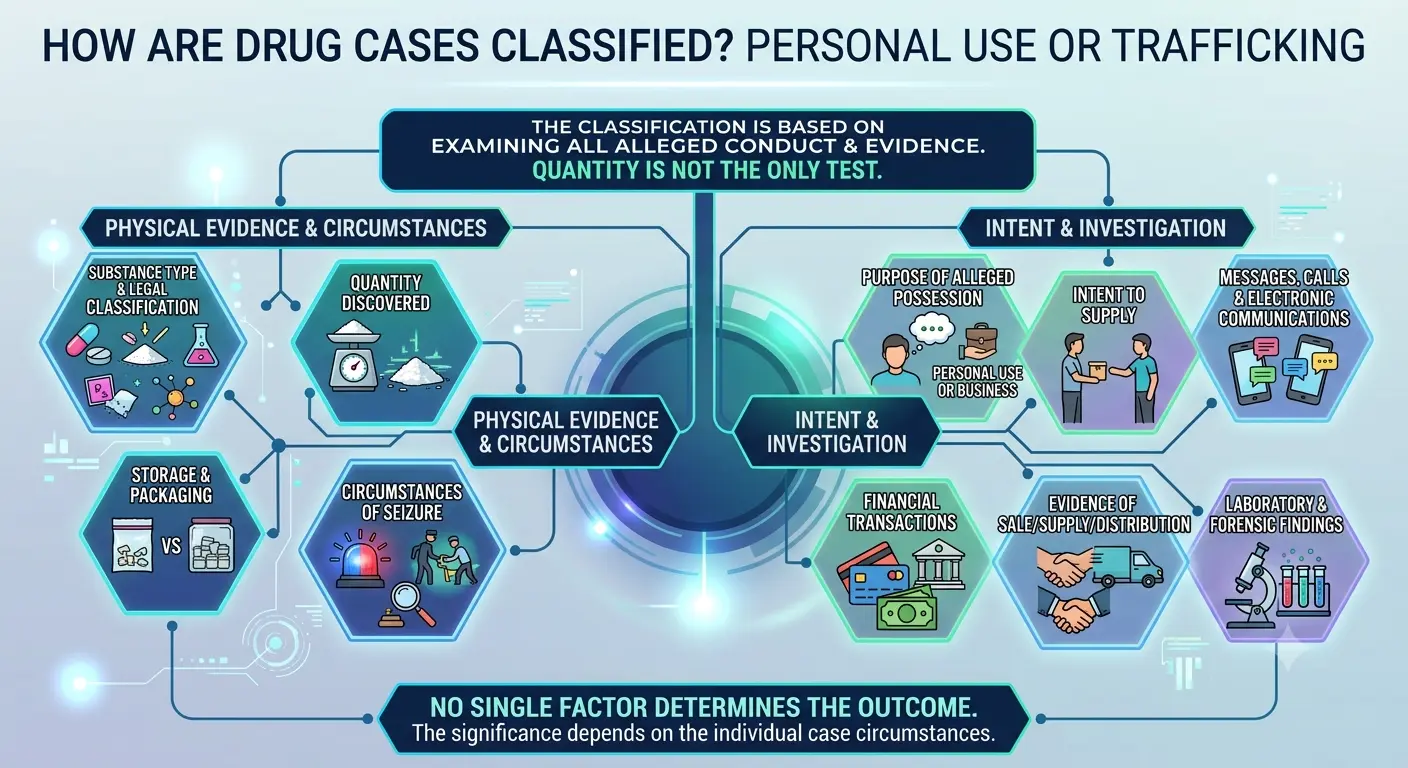
A drug case is classified by examining the alleged conduct and the evidence as a whole. Quantity can be relevant, but it should not be treated as a universal test under which possession automatically becomes trafficking above a single fixed amount.
Depending on the case, relevant factors may include:
- The purpose for which the substance was allegedly possessed.
- The type and legal classification of the drug or psychotropic substance.
- The quantity discovered.
- How the substance was stored or packaged.
- Whether another person was allegedly intended to receive it.
- Messages, calls, or other electronic communications.
- Financial transactions connected to the allegation.
- Evidence of sale, supply, delivery, or distribution.
- Laboratory and forensic findings.
- The circumstances in which the substance was seized.
No single item on this list automatically determines the outcome. The significance of each factor depends on the circumstances of the individual case.
Does the Quantity of Drugs Automatically Prove Trafficking?
No. The quantity of a controlled substance can be relevant evidence, but there is no general rule under which every drug case becomes trafficking merely because a particular weight is exceeded.
Quantity may become more significant when considered alongside other evidence. For example, authorities may examine whether substances were divided into packages, whether communications refer to supply or delivery, or whether financial evidence is allegedly linked to drug dealing.
This distinction is important for SEO as well as legal accuracy because users frequently search for a specific “amount” that separates possession from trafficking. Presenting a made-up universal threshold would be misleading.
Is Drug Possession the Same as Personal Use?
No. Possession and personal use are related but legally distinct concepts. Personal use concerns consumption, while possession concerns custody or control of the substance.
Possession can appear in different legal contexts. It may be connected to alleged personal use, but it may also form part of a more serious allegation depending on the alleged purpose and evidence.
A small amount does not automatically make possession lawful, and possession does not automatically amount to trafficking.
If your question specifically concerns the consequences of possessing a controlled substance, the guide to drug possession penalties in Dubai covers that issue separately without confusing possession with consumption or trafficking.
What Is the Punishment for Drug Use in Dubai in 2026?
There is no single punishment that applies to every drug-use offence in Dubai. The applicable penalty depends on the substance, the provision of the federal narcotics law, and whether the conduct is a first or repeat offence.
For personal-use offences falling within Article 41 of Federal Decree-Law No. 30 of 2021:
| Article 41 Situation | Potential Penalty |
|---|---|
| First offence | At least 3 months’ imprisonment OR a fine from AED 20,000 to AED 100,000 |
| Second offence within 3 years | At least 6 months’ imprisonment OR a fine from AED 30,000 to AED 100,000 |
| Third or subsequent offence | At least 2 years’ imprisonment AND a fine of at least AED 100,000 |
These figures apply to the categories covered by Article 41. They should not be presented as the universal punishment for every narcotic drug or psychotropic substance because other substances and circumstances may fall under different statutory provisions.
What Is the Punishment for Drug Trafficking in Dubai?
Drug trafficking offences can result in far more severe punishment than personal-use offences. The exact penalty depends on the substance, prohibited conduct, relevant schedule, intent, and the specific provision under which the offence is prosecuted.
Federal Decree-Law No. 30 of 2021 contains separate provisions dealing with possession or acquisition for trafficking or distribution and other forms of trafficking and promotion.
Under certain provisions and circumstances, penalties can reach life imprisonment or the death penalty.
For that reason, it would be inaccurate to say that every trafficking case carries one standard prison sentence or one fixed fine.
The question should instead be:
Which trafficking provision applies to the alleged conduct and substance?
That determination can materially affect the potential consequences of the case.
What Evidence Can Affect a Drug Trafficking Allegation?
The classification of a trafficking allegation may depend on physical, digital, financial, forensic, and testimonial evidence.
Examples can include:
- Communications allegedly discussing supply, price, quantity, or delivery.
- Bank transfers or other financial records.
- Packaging and storage circumstances.
- Evidence allegedly connecting the substance to another person.
- Laboratory analysis.
- Phone or device examinations.
- Statements made during investigation.
- The circumstances surrounding search and seizure.
The existence of one piece of evidence does not automatically establish trafficking. A criminal case requires the evidence to be assessed in its full legal and factual context.
Where the issue has moved from understanding the charge to challenging the prosecution evidence, the separate guide to drug crime defenses in Dubai addresses defense-related questions in greater detail.
Facing a Drug Investigation or Trafficking Allegation in Dubai?
Advocator can help you reach a lawyer whose experience matches the alleged offence and the stage your criminal case has reached.
What Happens to Non-Resident Foreigners Caught With Drugs at UAE Ports?
Certain non-resident foreigners caught when entering the UAE with specified controlled substances for personal use can fall under a special legal regime rather than the ordinary rules applying to every drug case.
Cabinet Resolution No. 43 of 2024 applies to qualifying non-resident foreigners arrested at land, sea, or airport entry points with substances and quantities covered by its Schedule.
For substances falling within Clauses 1–3 of the Schedule and where the legal requirements are satisfied:
- First occurrence: AED 5,000–20,000 fine.
- Second occurrence: AED 10,000–30,000 fine, deportation, and a 3-year entry ban.
- Third occurrence: AED 50,000–100,000 fine, deportation, and a permanent entry ban.
Different rules apply to other categories covered by the Resolution.
This regime is limited. It does not mean that carrying a small amount of drugs into Dubai is generally permitted, and it should not be confused with a trafficking case.
Can a Foreign Resident Be Deported After a Drug Conviction?
Yes. Federal narcotics law generally requires the court to order deportation of a foreigner convicted of an offence under the law, subject to the statutory exceptions contained in Article 75.
Deportation can therefore be a separate concern from imprisonment or fines in a drug case involving a non-UAE national.
The person’s residency status and the exact offence should be considered before drawing conclusions about the immigration consequences.
Can Rehabilitation Apply to a Drug Use Case?
Yes. UAE law provides treatment and rehabilitation mechanisms for certain qualifying personal-use or addiction cases. Rehabilitation is not, however, guaranteed simply because an allegation concerns personal use or because it is a person’s first offence.
Eligibility depends on the applicable provision and circumstances.
This is another important distinction between use and trafficking: treatment mechanisms that may be relevant in a qualifying personal-use situation should not automatically be assumed to apply to trafficking or promotion offences.
When Should You Speak With a Drug Crime Lawyer in Dubai?
Legal advice becomes particularly important once a drug matter moves beyond general legal research and into an investigation, summons, arrest, prosecution, or criminal judgment.
Consider obtaining legal advice if:
- You have been summoned or questioned about a controlled substance.
- The authorities allege trafficking instead of personal use.
- The purpose behind possession is disputed.
- Phone messages or financial transactions form part of the evidence.
- The matter arose at a Dubai airport or another UAE port.
- You are concerned about deportation as a foreign national.
- A criminal judgment has already been issued.
Advocator is a legal matching platform, not a law firm. The platform helps users reach a lawyer whose experience is relevant to the allegation and stage of the case. The lawyer engaged by the user remains responsible for assessing the evidence, providing legal advice, and handling any representation.
FAQs About Drug Use and Trafficking in Dubai
What is the main difference between drug use and trafficking in Dubai?
Personal use concerns unauthorized consumption for the individual’s own use, while trafficking involves conduct connected to supplying, distributing, promoting, dealing in, or otherwise trafficking controlled substances.
Does a certain quantity automatically turn possession into trafficking?
No. Quantity can be relevant evidence, but there is no universal amount that automatically converts every possession case into trafficking. The alleged intent and surrounding evidence also matter.
Is drug possession the same as drug use?
No. Drug use concerns consumption, while possession concerns custody or control of the substance. A possession allegation can arise without proof that the person actually consumed the substance.
Can sharing drugs with another person be treated differently from personal use?
Yes. Once an allegation involves supplying or making a controlled substance available to another person, legal provisions beyond personal consumption may become relevant. The exact classification depends on the facts and evidence.
Can a first-time drug offender receive rehabilitation?
Treatment or rehabilitation may be available in qualifying cases, but it is not automatic. The applicable legal provision and individual circumstances determine whether such a mechanism may apply.
Can foreigners be deported after a drug conviction in Dubai?
Yes. Deportation generally applies to foreign nationals convicted under the federal narcotics law, subject to statutory exceptions and special rules that may apply in particular circumstances.
Why is the distinction between drug use and trafficking important?
The distinction affects the potential offence, punishment, evidence that becomes relevant, available legal arguments, and overall defense strategy. Trafficking allegations can carry substantially more serious consequences than personal-use offences.
Need a Lawyer Suited to Your Drug Case in Dubai?
Tell Advocator what type of allegation you are facing and where the case stands, and the platform can help connect you with a suitable drug crime lawyer.
Conclusion
The difference between drug use and trafficking in Dubai depends primarily on the nature and purpose of the alleged conduct and the evidence supporting the charge.
Personal use relates to unauthorized consumption, possession is a separate legal concept, and trafficking involves significantly more serious conduct connected to supply, distribution, promotion, dealing, or other trafficking activity.
Quantity can be relevant, but it should not be treated as a universal trafficking threshold. The type of substance, communications, financial evidence, forensic findings, possession circumstances, and alleged purpose can all affect how a case is classified.
If you are already facing a drug-related investigation or charge, Advocator can help connect you with a lawyer suited to the nature and stage of the case. The lawyer you choose remains responsible for assessing your individual circumstances and providing legal advice.
This article provides general legal information and does not replace legal advice based on the facts of a specific case.

This article was written and legally reviewed by Dr. Mohamed Abdel Hamid Al Ramlawy-Attorney, Legal Consultant, and International Arbitrator (registered under No. 120365 since 29/01/1992). He brings over 30 years of practical experience in advocacy, litigation, legal consulting, contract drafting, and arbitration, with extensive expertise in criminal, civil, commercial, labor, Sharia, and administrative law.
He focuses on delivering clear and precise legal content to help readers understand their rights and options before taking action. His articles blend simplified language with deep practical experience, providing educational legal knowledge (which does not substitute for direct legal consultation on specific cases).