



A litigation lawyer in Dubai helps a claimant or defendant manage a legal dispute through the appropriate court process, from assessing jurisdiction and evidence to preparing pleadings, handling hearings, reviewing expert reports, challenging judgments where permitted, and enforcing the final outcome.
Table of Contents
What Does a Litigation Lawyer in Dubai Do?
Litigation means resolving a legal dispute through court proceedings. A litigation lawyer evaluates the claim or defence, determines the appropriate legal forum, organizes evidence, prepares legal submissions, manages procedural deadlines, and provides representation throughout the case.
The role can continue beyond the initial judgment. Depending on the case, litigation support may also involve an appeal, a challenge on points of law, settlement negotiations, or execution proceedings to enforce a judgment.
This differs from purely advisory legal work. A lawyer reviewing a contract before a dispute arises may be providing legal advice; once a claim is filed or defended before a court, the matter moves into litigation.
Not Sure Whether Your Dispute Should Go to Court?
The correct route depends on the dispute, contract, jurisdiction clause, and parties involved. Advocator can help you reach a lawyer whose experience matches your case and the relevant forum.
Which Disputes May Require Litigation in Dubai?
Litigation in Dubai can involve individuals, investors, companies, shareholders, landlords, tenants, contractors, creditors, debtors, and other parties. The correct strategy depends on the legal relationship and the remedy being requested.
Commercial and Contract Disputes
Commercial litigation commonly arises from breach of contract, unpaid invoices, failed business transactions, distribution agreements, service contracts, shareholder disagreements, or disputes between business partners.
A litigation lawyer will usually begin by reviewing the agreement, correspondence, payment records, contractual remedies, jurisdiction clause, and any dispute resolution provision before deciding whether court proceedings are appropriate.
Civil and Debt Claims
Civil litigation can involve contractual payment claims, compensation, liability, recovery of money, property-related rights, or other disputes between individuals or legal entities.
The procedural route may differ depending on whether the claim involves an ordinary lawsuit, an enforceable document, an urgent request, or another procedure available under UAE law.
Real Estate and Property Litigation
Property disputes require particularly careful forum selection because the competent authority may depend on the type of property relationship involved.
Issues involving developers, purchasers, ownership, contractual obligations, or investment disputes may overlap with real estate disputes in Dubai, while landlord and tenant matters can follow a more specialized route. An eviction lawsuit in Dubai, for example, should not automatically be treated like an ordinary commercial court claim.
Corporate, Shareholder and Construction Disputes
Corporate litigation may involve shareholder rights, management decisions, partnership breakdowns, director-related disputes, or breaches of corporate agreements.
Construction disputes often add another layer of complexity because technical evidence, project records, variations, payment certificates, delay analysis, and expert evidence may become central to the case.
Appeals and Judgment Enforcement
Litigation may continue after a first judgment if the decision is legally appealable. Once a final enforceable judgment exists, a separate execution stage may also be required if the losing party does not comply voluntarily.
Criminal appeals are governed by a different procedural framework and should not be merged with general civil or commercial litigation. Cases at that stage belong within the separate topic of a criminal appeal lawyer in Dubai.
Which Court or Forum Should Hear Your Dubai Dispute?
Jurisdiction should be checked before a claim is filed. Filing before the wrong court or ignoring an arbitration or jurisdiction clause can create delay, additional cost, and procedural objections.
Dubai Courts
Dubai Courts handle different first-instance case categories, including civil, commercial, labour, real estate, and personal status matters. The official Commercial Cases service describes case registration as the first degree of litigation and identifies electronic filing, supporting documents, and subsequent court sessions as part of the process.
The service also states that documents submitted in another language must be translated into Arabic through an approved legal translation process, while foreign-issued documents may require formal authentication depending on their origin and use.
The current procedural framework for onshore civil litigation is governed by the UAE Civil Procedure Code, while practical filing requirements should be checked against the relevant service before submission.
Current case-registration requirements for commercial matters can be verified through the Dubai Courts Commercial Cases service.
DIFC Courts
The DIFC Courts operate a separate English-language common law court system for civil and commercial disputes within their jurisdiction.
According to the official DIFC Courts jurisdiction guidance, the courts can hear civil or commercial disputes connected with the DIFC and may also hear certain disputes where the parties have expressly agreed in writing to submit to DIFC Courts jurisdiction.
This makes the jurisdiction clause in a commercial contract particularly important. A dispute should not be filed automatically in Dubai Courts simply because one party is located in Dubai.
What If the Contract Contains an Arbitration Clause?
An arbitration clause can materially change the dispute route. Before commencing court litigation, the contract should be reviewed to determine whether the parties agreed to resolve the dispute through arbitration instead.
The wording of the clause, designated seat, institution, governing law, scope of the clause, and parties covered by it can all affect the next procedural step.
How Does Litigation in Dubai Usually Progress?
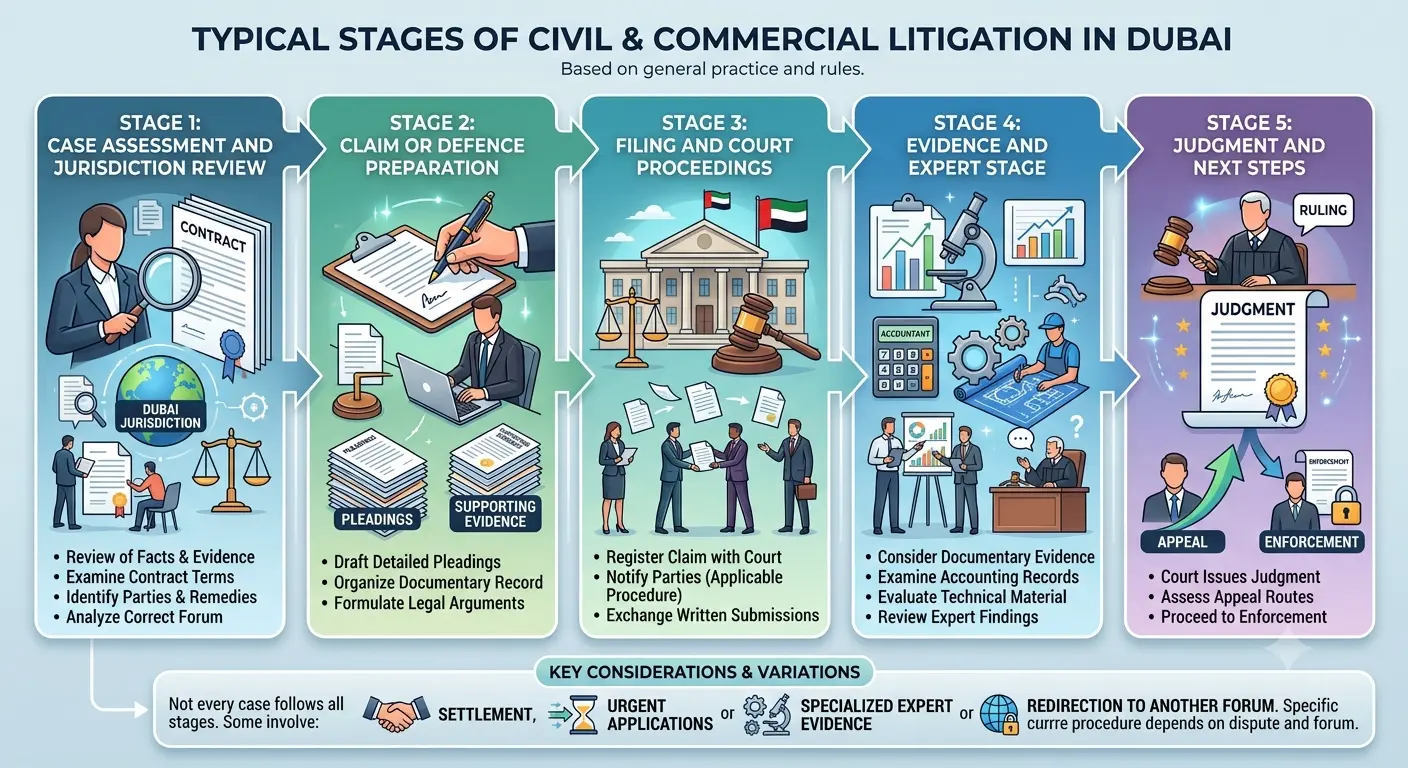
The exact procedure depends on the dispute and forum, but a civil or commercial case commonly develops through the following stages:
- Case assessment and jurisdiction review: the facts, contract, evidence, parties, remedies, and forum are examined before filing.
- Claim or defence preparation: pleadings are drafted and the supporting documentary record is organized.
- Filing and court proceedings: the claim is registered, parties are notified through the applicable procedure, and submissions are exchanged.
- Evidence and expert stage: depending on the dispute, the court may consider documentary evidence, accounting records, technical material, or expert findings.
- Judgment and next steps: the parties assess any available appeal route and, when appropriate, proceed to enforcement.
Not every dispute follows every stage. Some claims settle, some involve an urgent application, some require expert evidence, and others may be redirected because the contract gives jurisdiction to another forum.
What Documents Should You Prepare for a Litigation Lawyer?
A useful first case review depends on evidence rather than a verbal description alone. Prepare the documents that establish the relationship between the parties, what happened, and what remedy you want.
- The main contract, agreement, purchase order, lease, shareholder agreement, or other governing document.
- Invoices, payment records, bank transfers, receipts, account statements, or financial schedules relevant to the dispute.
- Email, WhatsApp messages, notices, letters, meeting records, and other correspondence showing the chronology.
- Any existing court papers, legal notices, expert reports, judgments, or arbitration documents.
- A short timeline identifying the key dates, breach, financial loss, and the outcome you are seeking.
For Dubai Courts proceedings, foreign-language and foreign-issued documents may require translation or authentication before they can be used in the form required by the court. Preparing this early can reduce avoidable filing problems.
Have a Contract, Claim or Court Notice Already?
Early review can identify jurisdiction issues, missing evidence, procedural deadlines, and whether court proceedings are the right strategy before the dispute becomes harder to manage.
Litigation vs Arbitration in Dubai: What Is the Difference?
Litigation and arbitration can both resolve disputes, but they are different legal processes. The correct option often depends on the contract and the type of dispute rather than personal preference alone.
| Factor | Litigation | Arbitration |
|---|---|---|
| Decision-maker | Court and judge | Arbitrator or arbitral tribunal |
| Basis of jurisdiction | Applicable court jurisdiction rules | Usually requires a valid arbitration agreement |
| Procedure | Governed by the applicable court procedural framework | Governed by the arbitration agreement, applicable law, and chosen rules |
| Privacy | Court process | Often selected where parties prefer a private dispute-resolution process |
| Review of decision | Appeal rights may exist depending on the judgment and applicable rules | Challenges to awards follow a different and generally narrower framework |
A litigation lawyer should therefore review the dispute resolution clause before recommending court action. Filing first and checking the clause later can create an unnecessary jurisdictional dispute.
Can a Dispute Be Resolved Without Going to Court?
Yes. A legal dispute does not always need to proceed to a final judgment.
Depending on the circumstances, the parties may consider direct negotiation, structured settlement discussions, mediation, or arbitration where an arbitration agreement exists. Even after a court case has started, settlement may remain commercially sensible if it produces an enforceable and acceptable resolution.
The decision should consider the strength of the evidence, urgency, value of the claim, relationship between the parties, cost of continued proceedings, and whether the other side has assets against which a judgment can eventually be enforced.
How Much Does Litigation Cost in Dubai?
There is no single fixed cost for litigation in Dubai. The overall cost depends on the type and value of the claim, the forum, legal fees, translations, expert work, document authentication, and whether the dispute continues through appeals or enforcement.
Dubai Courts publishes filing fees for its individual court services. For commercial cases, the official service currently calculates fees according to the nature and value of the application, so the applicable service should be checked before filing rather than relying on a generic estimate.
Legal representation fees are separate from court charges. Before instructing a lawyer, request a clear explanation of the proposed scope of work and whether the quotation covers only first-instance proceedings or also possible appeals and enforcement.
How Long Does Litigation Take in Dubai?
Litigation does not have one reliable duration that applies to every Dubai case. A straightforward documentary claim may progress differently from a construction, shareholder, financial, or cross-border dispute requiring experts and extensive evidence.
Timing may be affected by:
- The court or forum with jurisdiction.
- The complexity and number of parties.
- The need for translation, authentication, or technical evidence.
- The appointment of experts or requests for additional submissions.
- Whether the judgment is appealed and whether enforcement is later required.
A useful litigation assessment should therefore provide a case-specific procedural roadmap rather than promise a fixed completion date.
Why Enforcement Should Be Considered Before Filing a Lawsuit
Winning a judgment and recovering money are not always the same thing.
If the main objective is financial recovery, it is useful to consider from the beginning whether the opposing party has identifiable assets, where those assets are located, and what enforcement route may eventually be available.
This is particularly important in debt, commercial, shareholder, and cross-border disputes. A strong legal claim may still have limited commercial value if enforcement is ignored until after a final judgment.
A litigation strategy should therefore answer two questions from the outset: Can the claim succeed, and can the resulting judgment realistically be enforced?
How to Choose a Litigation Lawyer in Dubai
The right lawyer should match the specific dispute and forum rather than simply offering general legal services.
- Relevant dispute experience: choose experience connected to the actual problem, such as commercial, civil, construction, property, corporate, or debt litigation.
- Correct forum experience: Dubai Courts and DIFC Courts operate under different procedural and legal frameworks.
- Evidence-focused approach: the lawyer should identify missing contracts, correspondence, financial records, expert evidence, and procedural risks early.
- Clear scope and fees: understand what work is included and whether appeals or enforcement are outside the initial engagement.
- Practical communication: you should understand the strategy, risks, deadlines, and realistic next step without unnecessary legal jargon.
Advocator is a legal platform rather than a single law firm. It helps users identify the legal specialization required and reach a lawyer whose experience is relevant to the nature, forum, and procedural stage of the dispute.
FAQs About Litigation Lawyers in Dubai
What is litigation meaning in law?
Litigation means resolving a legal dispute through court proceedings. It normally includes filing or defending a claim, submitting evidence and legal arguments, attending the procedural stages required by the court, obtaining a judgment, and dealing with any permitted appeal or enforcement process. Litigation is different from purely advisory work and from arbitration, which follows a separate dispute-resolution framework.
Can DIFC Courts hear a dispute if my company is outside the DIFC?
Potentially, yes. DIFC Courts can hear civil and commercial matters that fall within their statutory jurisdiction, and the official jurisdiction framework also permits certain disputes where the parties have clearly agreed in writing to use DIFC Courts. The contract and jurisdiction clause should be reviewed before deciding where to file.
Can I use English documents in Dubai Courts?
Documents should be prepared in the form required by the relevant Dubai Courts service. The official Commercial Cases service states that documents requiring translation should be translated into Arabic through approved legal translation, and documents issued outside the UAE may also require authentication. Requirements should be confirmed for the specific case before filing.
What should I do if I receive a court claim in Dubai?
Do not ignore the claim or assume that an informal response is sufficient. Preserve the notice and all related documents, identify any response or hearing deadlines, review the jurisdiction and underlying agreement, and obtain case-specific legal advice promptly. Early preparation gives more time to organize evidence and address procedural objections.
Can a Dubai court judgment be appealed?
Some judgments may be challenged through an available appellate route, but the right to appeal depends on the type of decision, case value, procedural stage, and applicable law. Appeal deadlines can be important, so the judgment should be reviewed promptly rather than assuming that every decision has the same challenge period.
What happens after I win a litigation case?
If the losing party complies voluntarily, further proceedings may not be necessary. If payment or another obligation is not performed, an execution or enforcement process may be required. This is why asset position and enforcement strategy should be considered before filing the original claim, especially where financial recovery is the main objective.
Get Litigation Legal Support in Dubai
A dispute can become significantly harder to manage when the wrong forum is chosen, important evidence is missing, or procedural deadlines are addressed too late. Before filing or defending a case, identify the contract governing the relationship, organize the evidence, determine which court or dispute-resolution mechanism has jurisdiction, and define the result you actually need.
Advocator can help you reach a lawyer whose experience matches the type of litigation, relevant forum, and current stage of your dispute in Dubai.
Need Litigation Legal Support in Dubai?
Share the basic facts and stage of your dispute so Advocator can help you identify the legal specialization and litigation support appropriate to your situation.

This article was written and legally reviewed by Dr. Mohamed Abdel Hamid Al Ramlawy-Attorney, Legal Consultant, and International Arbitrator (registered under No. 120365 since 29/01/1992). He brings over 30 years of practical experience in advocacy, litigation, legal consulting, contract drafting, and arbitration, with extensive expertise in criminal, civil, commercial, labor, Sharia, and administrative law.
He focuses on delivering clear and precise legal content to help readers understand their rights and options before taking action. His articles blend simplified language with deep practical experience, providing educational legal knowledge (which does not substitute for direct legal consultation on specific cases).
