


UAE contract law governs how agreements are formed, performed, breached and terminated. Since 1 June 2026, the UAE has applied a new Civil Transactions Law, making it important to rely on the current legal framework rather than older contract guidance. Whether the agreement concerns services, a commercial transaction or property, the parties should understand their obligations, payment terms, termination rights and dispute provisions before signing. For matters requiring legal assistance, Advocator provides access to different legal practice areas in the UAE according to the nature of the agreement or dispute.
This guide explains the main UAE contract rules in practical terms, including contract formation, negotiations, breach, termination, compensation and dispute resolution.
Table of Contents
What Law Governs Contracts in the UAE?
The principal federal framework for civil contractual obligations is Federal Decree-Law No. 25 of 2025 Promulgating the Civil Transactions Law. It entered into force on 1 June 2026 and replaced Federal Law No. 5 of 1985.
The current law addresses contractual obligations as well as matters such as pre-contractual negotiations, agreed compensation, sale contracts and contracts for works. However, it is not the only legislation that can affect an agreement. Commercial, employment, consumer, real estate, arbitration or other special laws may apply depending on the transaction.
For this reason, the first step is to identify both the contract and the legal framework governing that particular relationship.
Need to Review a Contract Before Signing?
A legal review can identify unclear obligations, payment risks, termination clauses and dispute provisions before the agreement takes effect.
What Makes a Contract Valid Under UAE Law?
A contract should establish a sufficiently clear agreement between parties with the legal capacity and authority to enter into it. Its subject matter and obligations must also comply with applicable law.
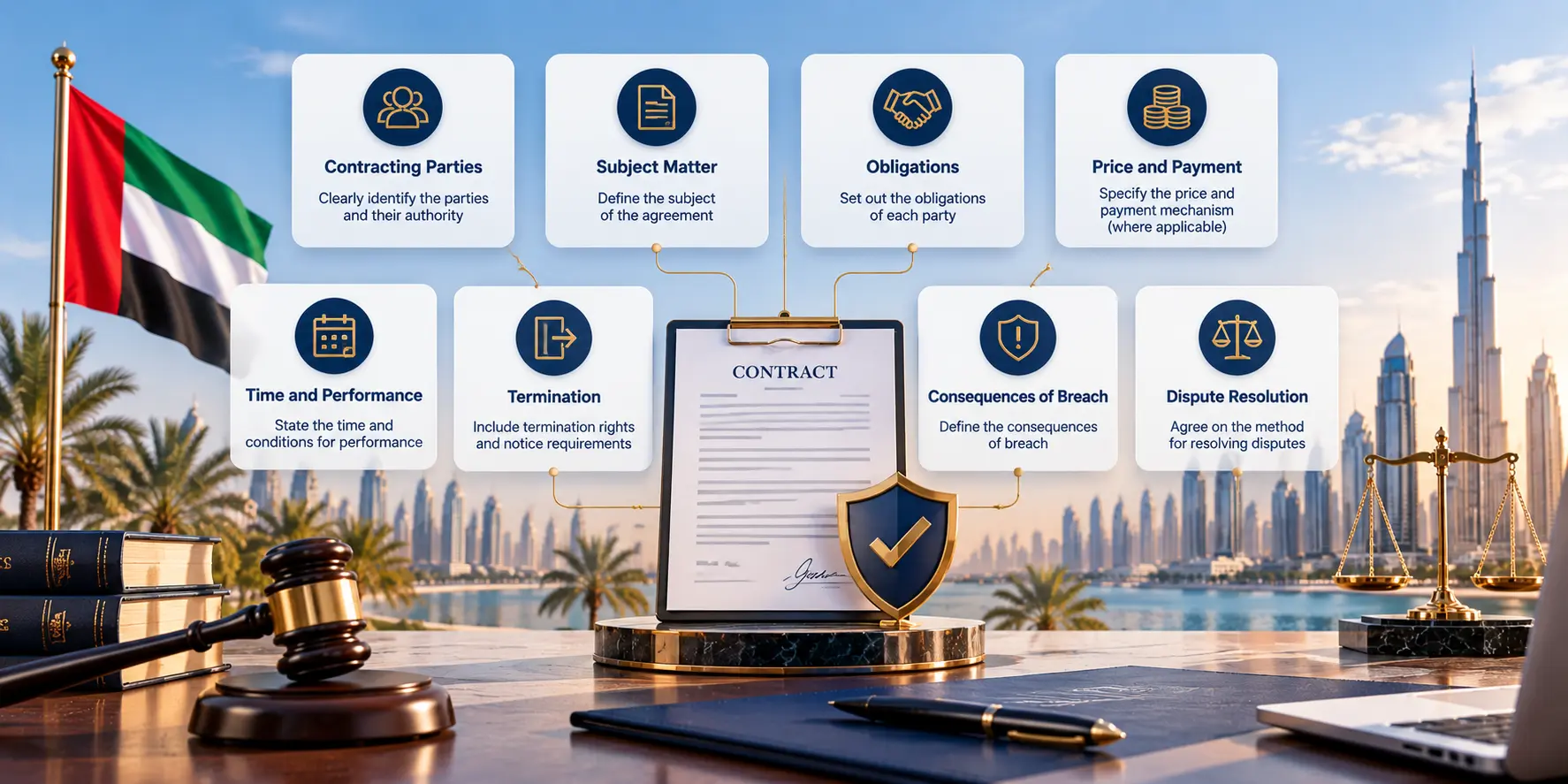
In practical terms, a well-drafted agreement should clearly identify:
- the contracting parties and their authority;
- the subject matter of the agreement;
- the obligations of each party;
- the price and payment mechanism, where applicable;
- the time and conditions for performance;
- termination rights and notice requirements;
- the consequences of breach; and
- the agreed method for resolving disputes.
Additional formalities may apply to certain transactions. For example, property transactions can involve registration and sector-specific requirements in addition to general contract rules. A Dubai real estate sale contract demonstrates how the requirements can change according to the subject of the agreement.
Are Verbal Contracts Valid in the UAE?
Not every contractual relationship necessarily requires one lengthy signed document. Whether a particular form is required depends on the transaction and applicable legislation.
However, relying on an oral agreement can create evidence problems if the parties later disagree about price, payment, performance or other terms. For significant transactions, written terms supported by invoices, emails, payment records and relevant documents provide a clearer record of what was agreed.
What Should Be Included in a UAE Contract?
There is no single UAE contract template suitable for every transaction. A commercial supply agreement, consultancy contract, construction agreement and property sale contract involve different obligations and risks.
| Contract Clause | What It Should Clarify |
|---|---|
| Parties | Legal names, capacity and authority to sign |
| Scope | Goods, services or obligations covered |
| Payment | Amount, currency, milestones and deadlines |
| Performance | What must be done, by whom and by when |
| Termination | When and how the contractual relationship may end |
| Liability | Consequences of delay, non-performance or breach |
| Notices | How contractual notices must be delivered |
| Disputes | The agreed court or arbitration route where applicable |
The more complex the transaction, the more carefully these provisions should be adapted. For example, a real estate development contract requires provisions that would not normally appear in a straightforward service agreement.
Do Pre-Contract Negotiations Matter Under UAE Law?
The current Civil Transactions Law gives specific attention to the period before the final contract is concluded, including negotiations and the disclosure of material information.
Parties should therefore avoid assuming that everything discussed before signature is legally irrelevant. Important representations about the subject matter, price, specifications or performance should be documented accurately.
It is also useful to distinguish clearly between preliminary discussions, non-binding proposals and terms that the parties intend to become legally binding.
What Is a Breach of Contract in the UAE?
A contractual breach may arise when a party fails to perform an obligation as agreed. Depending on the contract, this could involve non-performance, late performance, defective performance, failure to pay or another failure to comply with an agreed obligation.
Before alleging breach, review the relevant clause, deadline, conditions, notices and evidence of performance. The wording of the agreement can materially affect the available legal options.
This is particularly important where a contractual dispute operates within a specialised legal area. In a property transaction, for example, failure to pay, transfer or perform an SPA obligation can develop into a formal dispute. The guide to property dispute lawyers in Dubai explains how the contract, evidence, remedy and correct forum should be considered together.
What Should You Do After a Contract Is Breached?
Before terminating the agreement or demanding compensation, identify the exact obligation that was breached and check what the contract requires next.
- Review the relevant contractual obligation and deadline.
- Collect the signed agreement and amendments.
- Preserve invoices, payments, correspondence and other evidence.
- Check notice and cure requirements.
- Review the termination and dispute-resolution clauses.
- Determine which legal remedy may be available.
A message stating that the contract is “cancelled” does not necessarily produce the intended legal result. The appropriate action depends on the agreement, the breach and the applicable law.
Has the Other Party Breached the Contract?
Review the breach, evidence and notice requirements before terminating the agreement or starting a claim.
Can a Contract Be Terminated Under UAE Law?
Termination is not automatically available whenever a disagreement occurs. The right to end an agreement can depend on its terms, the nature of the breach, applicable legislation and whether the required notice or procedure has been followed.
Before terminating, check whether the contract contains a termination clause, notice period or opportunity to remedy the breach. The parties should also consider what happens after termination, including outstanding payments, return of property and obligations that continue after the agreement ends.
The correct route can differ where the contract concerns a regulated transaction. For example, failure to deliver possession of property can involve contractual obligations alongside property-specific rules, as explained in the guide to a property possession lawsuit in Dubai.
What Remedies Are Available for Breach of Contract?
There is no single remedy for every contractual breach. Depending on the agreement, applicable law and circumstances, the legal analysis may consider performance of an obligation, termination, recovery of money or compensation for recoverable loss.
Where compensation is claimed, evidence becomes particularly important. Relevant records may include the signed contract, amendments, invoices, payment confirmations, correspondence, formal notices and documents demonstrating the alleged loss.
The current Civil Transactions Law also contains rules relevant to agreed contractual compensation. Therefore, a compensation amount written into a contract should not automatically be assumed to operate exactly as one party expects in every situation. Its application depends on the contractual circumstances and current legal framework.
Which Court or Arbitration Tribunal Handles a Contract Dispute?
There is no single forum for every UAE contractual dispute. Jurisdiction can depend on the parties, subject matter, location, applicable legislation and the dispute-resolution clause in the agreement.
A contract may provide for a particular court or contain an arbitration agreement. Where arbitration is used, the clause should clearly address the agreed mechanism and should not simply be copied from another contract without understanding its effect.
The nature of the underlying transaction can also change the correct route. Dubai property disputes, for example, may involve courts, arbitration or specialised authorities depending on the issue. The distinction is discussed separately in the guide to real estate disputes in Dubai.
Before commencing proceedings, review the dispute clause and determine which authority actually has jurisdiction over the claim.
Does UAE Contract Law Apply to Real Estate Agreements?
General contract principles can apply to real estate agreements, but property transactions are also governed by specialised federal and emirate-level requirements. Buyers, sellers, developers and investors should therefore avoid relying on general contract law alone where property-specific rules apply.
The same principle applies to authority to execute a transaction. If another person signs or acts for a property owner, the scope and validity of that authority should be checked. The requirements are explained in the guide to power of attorney for Dubai property.
Employment, company, consumer and other regulated agreements can follow the same general pattern: UAE contract principles may be relevant, but special legislation can modify the rights, procedures or remedies available.
Common Contract Mistakes to Avoid in the UAE
Many disputes begin with unclear drafting rather than an unusual legal problem. Common mistakes include:
- using an incorrect company name or failing to verify signing authority;
- leaving the scope of work or deliverables unclear;
- using vague payment milestones;
- failing to define termination and notice procedures;
- using inconsistent terms across the contract and appendices;
- ignoring the dispute-resolution clause until a dispute arises; and
- relying on outdated UAE contract-law references after the 2026 changes.
A contract should reflect the actual transaction. Adding more clauses does not necessarily make an agreement safer if those clauses contradict each other or do not match how the parties intend to perform their obligations.
When Should a UAE Contract Be Legally Reviewed?
Legal review is particularly useful before signing a high-value agreement, making a substantial advance payment, accepting significant liability, terminating an existing agreement or agreeing to an unfamiliar dispute forum.
A lawyer can review the parties and their authority, performance and payment obligations, termination provisions, liability clauses and the chosen dispute mechanism. For an existing dispute, the review should also consider the evidence and the remedy the client is seeking.
Advocator is a specialised legal platform that helps users reach a lawyer whose experience matches the type and stage of the contractual issue, whether the matter concerns drafting, review, breach, termination or a formal dispute.
Frequently Asked Questions About UAE Contract Law
What is the main contract law in the UAE in 2026?
The main federal civil framework is Federal Decree-Law No. 25 of 2025 Promulgating the Civil Transactions Law, which entered into force on 1 June 2026 and replaced Federal Law No. 5 of 1985. Special legislation may also apply depending on the transaction.
Does a UAE contract have to be in writing?
The required form depends on the type of agreement and applicable legislation. Certain transactions require specific formalities. Even where a particular written form is not mandatory, documenting important obligations can reduce uncertainty and make the terms easier to prove if a dispute arises.
Can I cancel a contract after signing it in the UAE?
There is no general right to cancel every contract simply because one party changes its mind. Termination depends on the agreement, applicable law and circumstances. Check the termination clause, notice requirements and any relevant breach before taking action.
What happens if someone breaches a contract in the UAE?
The consequences depend on the obligation breached, the agreement and applicable law. Depending on the circumstances, legal remedies may involve performance, termination, recovery of money or compensation. The contract and supporting evidence should be reviewed before selecting a remedy.
Can I claim compensation for breach of contract?
Compensation may be available where there is a proper legal basis and the relevant requirements are established. The alleged breach and loss should be supported by evidence. Any agreed compensation clause must also be considered under the applicable UAE legal framework.
Can a UAE contract include an arbitration clause?
Yes, contracts may contain arbitration agreements where legally permissible. Because the clause can determine how a future dispute is handled, its scope and the agreed arbitration mechanism should be reviewed carefully before the contract is signed.
Understanding Your Rights Under UAE Contract Law
UAE contract law matters both before and after a dispute. Clear terms on performance, payment, termination, liability and dispute resolution can reduce uncertainty before the parties begin performing their obligations. Since the new Civil Transactions Law took effect on 1 June 2026, contracts and legal guidance should also be checked against the current framework. If a breach has already occurred, review the agreement and evidence before choosing the next legal step.
Have a Contract Question in the UAE?
Advocator helps you access a lawyer whose experience matches your contract and the current stage of your legal issue.

This article was written and legally reviewed by Dr. Mohamed Abdel Hamid Al Ramlawy-Attorney, Legal Consultant, and International Arbitrator (registered under No. 120365 since 29/01/1992). He brings over 30 years of practical experience in advocacy, litigation, legal consulting, contract drafting, and arbitration, with extensive expertise in criminal, civil, commercial, labor, Sharia, and administrative law.
He focuses on delivering clear and precise legal content to help readers understand their rights and options before taking action. His articles blend simplified language with deep practical experience, providing educational legal knowledge (which does not substitute for direct legal consultation on specific cases).