



A commercial lawyer in Dubai helps businesses manage the legal side of contracts, transactions, business relationships, risk, and commercial disputes. You may need one before signing a high-value agreement, entering a joint venture, dealing with a serious contract breach, recovering unpaid amounts, or deciding how a business dispute should be resolved.
The right legal support depends on the problem itself. A company seeking contract advice does not necessarily need the same expertise as one preparing for court proceedings or dealing with a shareholder conflict.
This guide explains what commercial lawyers do, when businesses should involve one, how commercial work differs from corporate and litigation work, what to prepare before seeking legal assistance, and how to identify a suitable lawyer in Dubai.
Table of Contents
What Does a Commercial Lawyer in Dubai Do?
A commercial lawyer advises businesses on the legal issues arising from their day-to-day operations and commercial relationships. The work usually focuses on preventing contractual and transactional problems, allocating business risk clearly, and responding when a commercial relationship breaks down.
Typical areas include:
- Commercial contracts: drafting, reviewing, and negotiating agreements with customers, suppliers, distributors, service providers, and business partners.
- Business transactions: reviewing transaction structures, commercial terms, obligations, and risk allocation before a deal is completed.
- Partnerships and joint ventures: clarifying decision-making, financial obligations, exit rights, and dispute mechanisms between the parties.
- Commercial risk and compliance: identifying legal exposure arising from business practices, contractual commitments, or regulatory requirements.
- Commercial disputes: assessing breaches, non-payment, termination issues, and the most appropriate route for resolving the dispute.
The objective is not simply to react after a dispute starts. Commercial legal work is often most valuable before a business commits to a contract, payment obligation, partnership, or transaction that may be difficult to reverse.
Not Sure Which Commercial Legal Specialist Your Business Needs?
Advocator helps connect your contract, transaction, or business issue with a lawyer whose experience fits the matter and its current stage.
Commercial Lawyer vs Corporate Lawyer vs Litigation Lawyer
A commercial lawyer primarily deals with business transactions, contracts, and trading relationships. A corporate lawyer focuses more heavily on the company itself—its ownership, structure, governance, shares, and corporate transactions—while a litigation lawyer focuses on disputes that have moved toward formal court proceedings.
The areas frequently overlap, so the label alone should not determine whom a business chooses.
| Type of Lawyer | Primary Focus | Typical Business Matter |
|---|---|---|
| Commercial Lawyer | Contracts and commercial relationships | Supply agreement, distribution arrangement, payment dispute, contract termination |
| Corporate Lawyer | Company structure and ownership | Shareholder agreement, restructuring, investment, share transfer, corporate governance |
| Litigation Lawyer | Formal disputes and court proceedings | Breach-of-contract claim, recovery action, contested commercial proceedings |
For example, a new joint venture may require both commercial contract work and corporate structuring. If that relationship later collapses and proceedings begin, litigation expertise may become necessary.
The practical question is therefore not merely, “Do I need a commercial or corporate lawyer?” It is:
What legal task needs to be completed at the current stage of the business matter?
When Should a Business Hire a Commercial Lawyer in Dubai?
A business should consider involving a commercial lawyer when a decision creates meaningful contractual, financial, operational, or dispute risk. Waiting until litigation begins can mean that the most important contract terms or strategic options have already been fixed.
Common situations include:
- Before signing an important contract: particularly where the agreement creates long-term payment, exclusivity, liability, delivery, or termination obligations.
- Before entering a partnership or joint venture: where control, investment, profit sharing, exit rights, or deadlock need to be defined clearly.
- When a counterparty breaches an agreement: especially if money is unpaid, performance has stopped, or termination is being considered.
- When the correct dispute forum is unclear: for example, where the contract contains jurisdiction or arbitration provisions.
- Before taking a step that may trigger liability: such as terminating a distributor, withholding payment, cancelling a contract, or making a formal accusation against another business.
Early advice is particularly useful when a business still has several options. Once a notice has been sent, an agreement terminated, or proceedings commenced, some strategic choices may become narrower.
Which Laws Affect Commercial Business Matters in Dubai in 2026?
Commercial matters in Dubai are not governed by one single statute. The applicable framework depends on the transaction, parties, contract, company structure, sector, and dispute.
A central federal statute is **Federal Decree-Law No. 50 of 2022 concerning the Commercial Transactions Law**, which regulates a broad range of commercial activities and obligations involving merchants and commercial transactions.
Contractual relationships must also be considered against the UAE’s wider law of obligations. A particularly important 2026 development is the new Civil Transactions Law, which introduced a more developed framework for pre-contractual negotiations and an obligation to disclose fundamental information relevant to informed contracting. It also recognises framework agreements for recurring or long-term contractual relationships.
This matters commercially because legal risk may begin before the final agreement is signed. What is represented, disclosed, negotiated, documented, and agreed during the pre-contract stage can become important when the parties later disagree over their obligations.
Corporate structure, shareholder rights, sector-specific regulations, free-zone rules, and the wording of the contract itself may add further layers. A commercial lawyer should therefore identify the legal framework relevant to the particular transaction instead of applying the same checklist to every Dubai business.
How Can a Commercial Lawyer Help With Business Contracts?
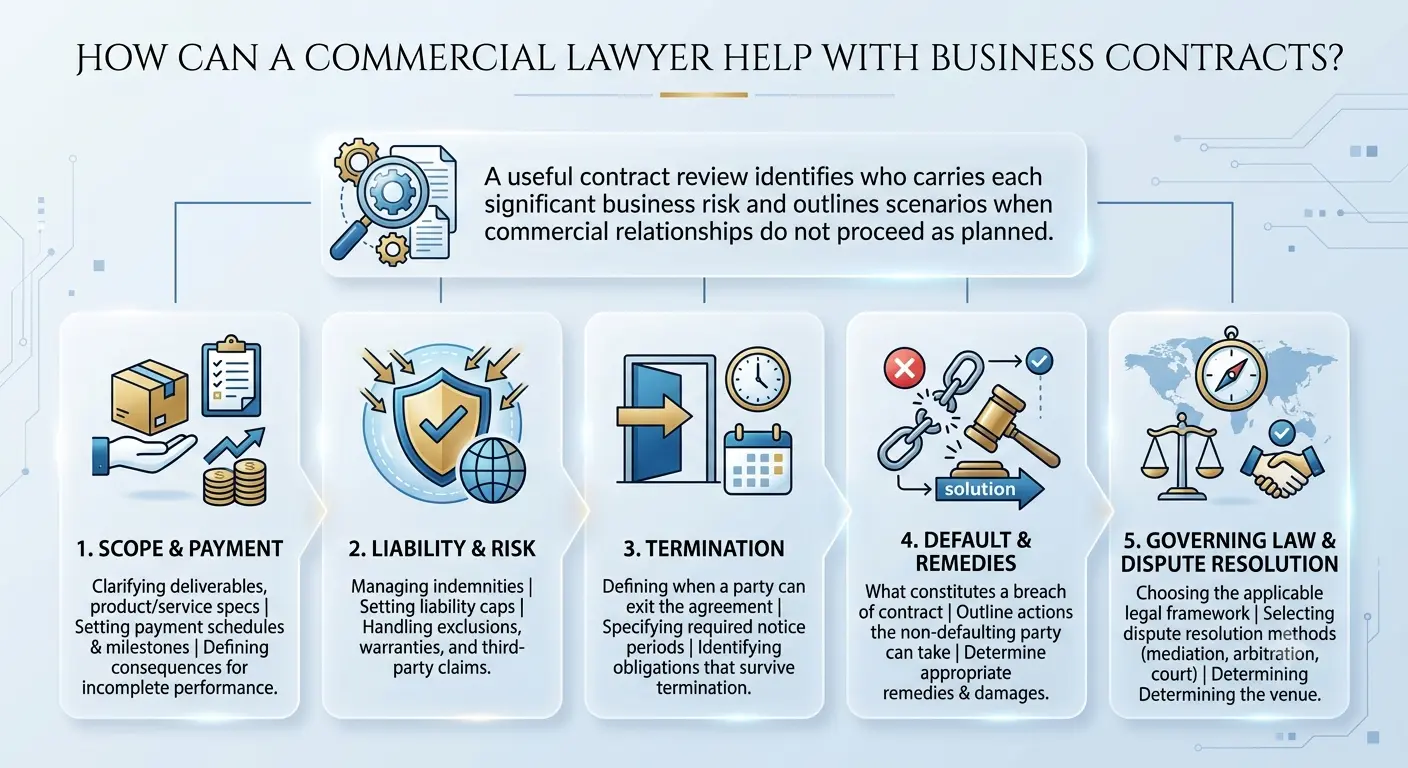
A commercial lawyer does more than correct the wording of a contract. A useful contract review identifies who carries each significant business risk and what happens when the commercial relationship does not proceed as planned.
Five areas deserve particular attention:
- Scope and payment: what each party must deliver, when payment is due, and what happens if performance is incomplete.
- Liability: indemnities, liability caps, exclusions, warranties, and responsibility for third-party claims.
- Termination: when a party may exit, what notice is required, and which obligations survive termination.
- Default and remedies: what constitutes breach and what the non-defaulting party may do next.
- Governing law and dispute resolution: where and how a future dispute will be decided.
The commercial context matters as much as the wording. A construction, technology, distribution, service, or property transaction may require different risk provisions.
For example, where the transaction concerns property development, the obligations and risk allocation contained in a real estate development contract require more specialised treatment than an ordinary supply or consultancy agreement.
How Are Commercial Disputes Resolved in Dubai?
Commercial disputes may be resolved through negotiation, settlement, arbitration, or litigation, depending on the contract, applicable law, nature of the claim, and agreed dispute-resolution mechanism.
The first step should usually be to identify:
- What obligation was allegedly breached.
- What evidence establishes the agreement and breach.
- Whether any notice or contractual procedure must be followed.
- What dispute-resolution clause the parties agreed.
- What commercial outcome the business is actually trying to achieve.
A business seeking payment may have a different objective from one trying to preserve a long-term supplier relationship. Likewise, a shareholder dispute may require a different strategy from a straightforward unpaid invoice.
The subject matter can also determine which specialist experience is useful. A contract dispute arising from a property transaction may overlap with real estate disputes in Dubai rather than ordinary trading litigation.
It is also important to distinguish a genuine contractual dispute from facts suggesting dishonesty. A disagreement about contractual performance is not automatically fraud. Where there is evidence of deliberate deception, false documentation, misuse of company assets, or similar conduct, the issue may overlap with corporate fraud and white-collar crimes in Dubai and require a different legal assessment.
Has a Contract or Payment Dispute Escalated?
Tell Advocator whether the issue involves a breach, unpaid sums, a shareholder conflict, or another commercial dispute, and the platform can help you reach a suitable lawyer.
Does Mainland, Free-Zone, or DIFC Status Affect Commercial Legal Work?
Yes. The business’s legal structure, licensing jurisdiction, contract wording, and agreed dispute forum can affect which rules and procedures are relevant.
A Dubai business may operate through a mainland entity, a free-zone company, or a structure connected to the DIFC. A transaction may also involve a counterparty established in another jurisdiction.
This does not mean every matter becomes a jurisdictional dispute. It does mean that a lawyer reviewing a commercial issue should establish early:
- Which entities actually signed the contract.
- Where those entities are incorporated and licensed.
- Which law the agreement says will govern it.
- What court or arbitration mechanism has been selected.
- Whether the transaction or dispute crosses more than one jurisdiction.
These questions should be answered before a serious dispute strategy is chosen.
How Do You Verify and Choose a Commercial Lawyer in Dubai?
Start by checking professional registration, then assess whether the person’s actual experience matches the commercial problem you need to solve.
The Government of Dubai Legal Affairs Department maintains a directory containing registered advocates and legal consultants, as well as advocacy and legal consultancy firms licensed by the Department. Importantly, the Department states that the directory does **not** provide information about a practitioner’s legal specialisation and does not constitute a recommendation or endorsement of a particular legal service provider.
This creates an important distinction:
Registration tells you whether a practitioner or firm appears in the official framework; it does not by itself tell you whether that person is the best fit for a particular commercial contract, transaction, or dispute.
When comparing commercial lawyers, consider:
- Experience with the type of contract or dispute involved.
- Familiarity with the relevant business sector.
- Whether the matter is advisory, transactional, arbitral, or court-based.
- Ability to explain risks and options in commercial rather than purely theoretical terms.
- Clarity about scope of work, responsibility, and fees.
This is also where Advocator’s role differs from a government directory. Advocator is a legal matching platform: it helps users identify the type of lawyer appropriate to the matter and reach a practitioner whose experience is relevant to the problem. It is not itself a law firm and does not provide courtroom representation.
What Documents Should You Prepare Before Speaking to a Commercial Lawyer?
Prepare the documents that show the commercial relationship, what went wrong, and what outcome your business wants. A complete first review is usually more useful than sending isolated screenshots or explaining the dispute from memory.
Start with:
- The signed contract and all amendments, schedules, purchase orders, or side agreements.
- Relevant company or authority documents identifying the parties and authorised signatories.
- Invoices, payment records, account statements, or transaction evidence.
- Important emails, notices, messages, and correspondence relating to performance or breach.
- A short chronological summary explaining what happened and the outcome the business is seeking.
If no contract was formally signed, gather the documents that may show how the relationship was formed and performed, such as proposals, accepted quotations, invoices, emails, purchase orders, and payment records.
How Much Does a Commercial Lawyer Cost in Dubai?
There is no single standard fee for a commercial lawyer in Dubai. Cost depends on the scope of work, complexity, value and risk of the transaction or dispute, number of documents, urgency, seniority required, and whether the work is advisory, transactional, arbitral, or contentious.
A short contract review should not be assumed to cost the same as:
* negotiating a complex joint venture;
* conducting extensive due diligence;
* managing a shareholder dispute; or
* representing a company in formal proceedings.
Before instructing a lawyer, ask for clarity on:
- The exact scope of work.
- Whether the fee is fixed, hourly, staged, or structured another way.
- What work is excluded from the quoted scope.
- Whether court, arbitration, expert, translation, or other external costs are separate.
- What happens if the matter expands beyond the original instruction.
Choosing solely on the lowest quote can be a poor comparison if the proposed scopes are not the same.
How Does Advocator Help You Find a Commercial Lawyer in Dubai?
Advocator helps businesses move from a broad search for “commercial lawyers in Dubai” to a more useful question: what type of commercial lawyer fits this particular matter?
The matching process should take account of factors such as:
- The type of issue—contract, transaction, partnership, compliance concern, or dispute.
- The current stage—planning, negotiation, breach, settlement, arbitration, or litigation.
- The business sector and legal context.
- The jurisdiction or dispute forum involved.
Advocator does not replace the lawyer’s legal assessment. Once connected, the lawyer remains responsible for reviewing the documents, advising on legal options, agreeing the scope and fees, and carrying out any legal representation.
FAQs About Commercial Lawyers in Dubai
Can a commercial lawyer help a startup in Dubai?
Yes. A commercial lawyer can help a startup review founder arrangements, supplier and customer contracts, investment terms, confidentiality obligations, and other business agreements. The exact support required depends on the startup’s structure, industry, financing, and stage of growth.
Should a lawyer review a supplier or distribution agreement before signing?
A legal review is particularly useful when the agreement creates substantial payment commitments, exclusivity, minimum purchase obligations, territorial restrictions, indemnities, or difficult termination provisions. Reviewing these risks before signature usually leaves more room to negotiate them than after a dispute begins.
Can a commercial lawyer help recover unpaid invoices?
Yes, where unpaid invoices arise from a commercial relationship, a lawyer can assess the underlying contract, proof of delivery or performance, payment terms, correspondence, notices, and available dispute route. The correct next step depends on the evidence and contractual arrangements rather than the invoice alone.
Does a DIFC or free-zone dispute require different legal experience?
It can. The entity’s jurisdiction, contract, governing-law clause, and dispute-resolution provision may change the relevant legal framework and forum. A business should therefore identify these points before choosing a lawyer or commencing formal proceedings.
Can the same commercial lawyer advise on a contract and later handle court proceedings?
Possibly, but businesses should confirm the practitioner’s registration, permitted scope of practice, and right of audience for the relevant forum. Commercial advisory experience and formal court representation are related but not identical requirements.
Should I seek legal advice before terminating a commercial contract?
It is often prudent to do so where termination could trigger financial liability or a dispute. The contract may prescribe notice periods, cure periods, termination grounds, payment consequences, or dispute procedures that should be reviewed before a termination notice is issued.
Conclusion
A commercial lawyer in Dubai can be useful long before a business reaches court. The right lawyer may help clarify contract risk, structure a transaction, protect a commercial relationship, or determine the correct response when a counterparty breaches its obligations.
The key is matching the lawyer’s experience to the actual task rather than choosing only by title or visibility online. For businesses unsure which commercial legal specialism fits their situation, Advocator can help identify the relevant type of lawyer and facilitate that connection.
Need the Right Commercial Lawyer in Dubai?
Share the type of business matter and its current stage with Advocator to be connected with a lawyer whose experience fits the issue.

This article was written and legally reviewed by Dr. Mohamed Abdel Hamid Al Ramlawy-Attorney, Legal Consultant, and International Arbitrator (registered under No. 120365 since 29/01/1992). He brings over 30 years of practical experience in advocacy, litigation, legal consulting, contract drafting, and arbitration, with extensive expertise in criminal, civil, commercial, labor, Sharia, and administrative law.
He focuses on delivering clear and precise legal content to help readers understand their rights and options before taking action. His articles blend simplified language with deep practical experience, providing educational legal knowledge (which does not substitute for direct legal consultation on specific cases).
