



Cybercrime poses a significant threat to individuals and businesses across the United Arab Emirates. As digital interactions, e-commerce, and online banking expand, understanding how the legal framework of Dubai and the UAE addresses digital offenses—and knowing the exact procedures to report them—is essential for protecting your rights, financial security, and personal safety.
This comprehensive guide covers everything you need to know about cybercrime laws in Dubai, step-by-step reporting procedures through official portals, crucial emergency contact details, and strategic legal remedies.
Table of Contents
Understanding UAE Cybercrime Law: Federal Decree-Law No. 34 of 2021
The primary legal framework governing digital offenses in the UAE is Federal Decree-Law No. 34 of 2021 on Combatting Rumors and Cybercrimes. This legislation provides robust protection against a wide array of online threats and establishes strict penalties for violators.
Key Categories of Cybercrimes Recognized in the UAE
- Online Fraud and Financial Scams: Unauthorized access to bank accounts, phishing scams, fraudulent online stores, and identity theft aimed at financial gain.
- Hacking and Unauthorized Access: Unlawful entry into personal or corporate networks, emails, databases, or social media accounts.
- Online Defamation and Libel: Publishing false information, insults, or defamatory statements against individuals or corporations via social media, messaging apps, or public forums.
- Cyber Extortion and Blackmail (Sextortion): Threatening to release sensitive photos, private data, or confidential information unless money or favors are provided.
- Privacy Infringements and Unauthorized Photography: Capturing photos or videos of individuals without consent, eavesdropping, or leaking private communications.
- Cyber Sabotage and Malware Distribution: Deliberately infecting systems with ransomware, spyware, or viruses to disrupt operations or destroy data.
Victim of Online Fraud, Blackmail, or Hacking in the UAE?
Protect your personal assets and get immediate legal assistance to report cybercrimes safely and confidentially.
How to Report Cybercrime in Dubai and the UAE
The UAE government and Dubai Police have instituted streamlined, secure digital channels for reporting cybercrimes. Depending on your jurisdiction and the nature of the crime, you can utilize the following reporting methods:
1. The Dubai Police eCrime Portal (Primary Channel for Dubai)
The eCrime portal is the official platform managed by Dubai Police for handling all internet-based offenses.
- How to Submit:
- Access the eCrime portal or open the Dubai Police App.
- Select whether the complaint is personal or on behalf of a corporate entity.
- Enter your Emirates ID (or passport details for non-residents) and active contact details.
- Provide a detailed summary of the incident, including date, time, platform used, and financial loss incurred (if applicable).
- Upload supporting evidence (screenshots, chat logs, email headers, transaction receipts).
- Submit the report to receive a reference tracking number.
2. Ministry of Interior (MOI) UAE App (For Other Emirates)
For offenses occurring outside Dubai (such as Abu Dhabi, Sharjah, Ajman, Ras Al Khaimah, Fujairah, or Umm Al Quwain), the Ministry of Interior provides a unified reporting system.
- App: MOI UAE (Available on iOS and Android)
3. Reporting via “My Safe Society” App
Managed by the UAE Federal Public Prosecution, the My Safe Society mobile app allows residents to report suspicious online activities, cyber threats, and security breaches directly to prosecutors.
4. Reporting In-Person at Police Stations
If you require immediate assistance or face severe blackmail/threats, you can visit the nearest police station in Dubai (such as Al Muraqqabat, Bur Dubai, or Al Barsha police stations) or the Criminal Investigation Department (CID) headquarters.
Essential Emergency Contact Numbers and Official Details
When dealing with active cyber attacks, financial fraud, or extortion, prompt communication with official authorities is vital.
| Contact Channel | Official Detail / Number | Specific Use Case |
|---|---|---|
| Emergency Police Line | 999 | Immediate physical threat or active crime in progress. |
| Non-Emergency Police Line | 901 | General legal inquiries and non-urgent police assistance. |
| Dubai Police eCrime Platform | www.ecrime.ae | Official online filing for all Dubai cybercrime complaints. |
| Dubai Police WhatsApp Contact | +971 4 609 9999 | Virtual assistant inquiries and location services. |
| Aman Service (Abu Dhabi) | 800 2626 | Anonymous reporting of crimes and cyber threats in Abu Dhabi. |
| Al Ameen Service (Dubai) | 800 4888 | Confidential reporting of extortion, security issues, and threats. |
| Dubai Police Official Email | mail@dubaipolice.gov.ae | Written inquiries and documentation submission. |
| Dubai Police Cybercrime Dept. | +971 4 601 9999 | Direct phone line for specialized cybercrime support. |
Need Assistance Filing a Formal Legal Complaint in Dubai?
Our legal experts can guide you in preserving evidence, drafting formal reports, and protecting your interests before local authorities.
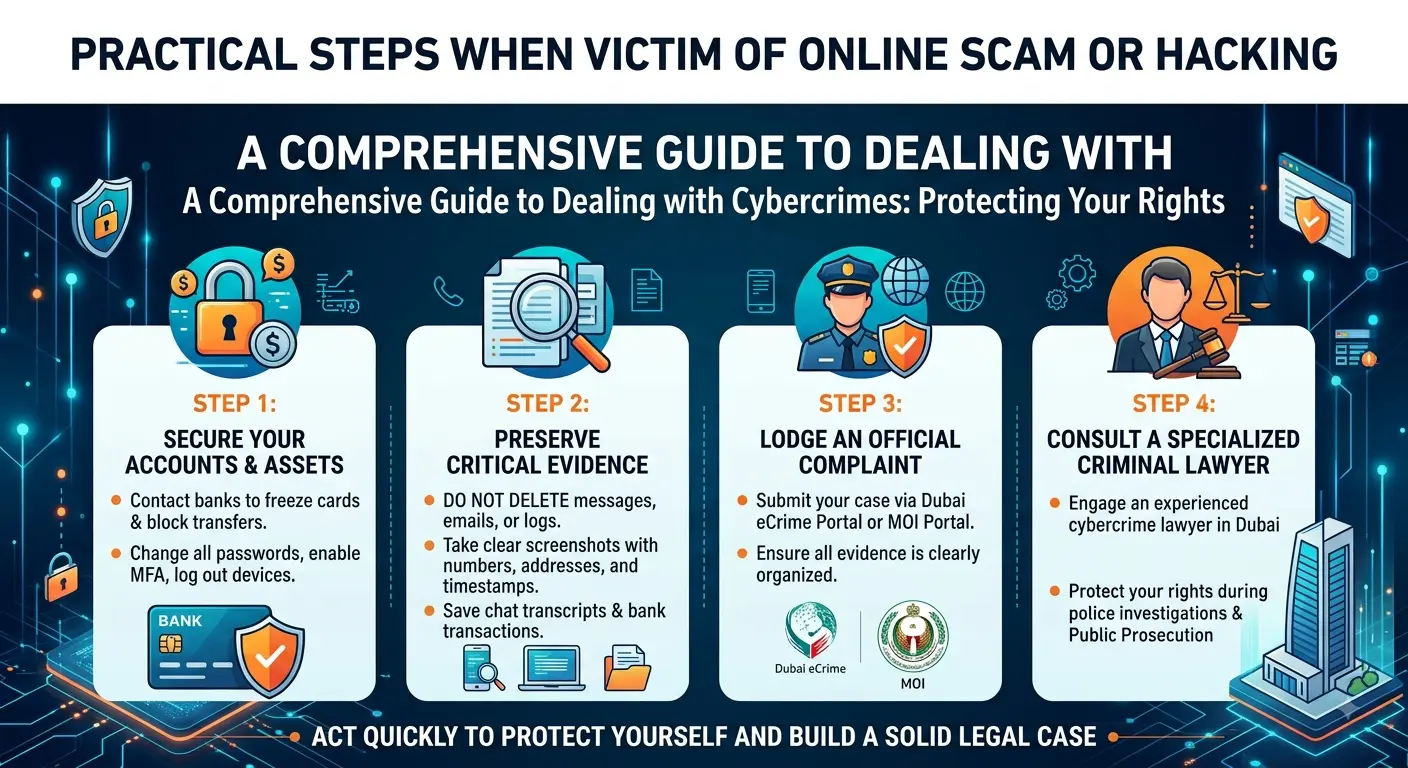
Step-by-Step Guide: What to Do If You Fall Victim to an Online Scam or Hacking
If you suspect you have been targeted by online fraudsters, hackers, or blackmailers, follow these steps immediately to mitigate damage and build a solid legal case:
Step 1: Secure Your Accounts and Assets
- Financial Accounts: Immediately contact your bank to freeze compromised credit cards, block fraudulent transfers, and secure online banking credentials.
- Digital Credentials: Change passwords across all accounts, enable Multi-Factor Authentication (MFA), and log out of active sessions on all devices.
Step 2: Preserve Critical Evidence
Do not delete any messages, emails, or logs. Legal authorities and courts require verifiable proof.
- Take clear screenshots displaying full phone numbers, email addresses, social media handles, URL links, and timestamps.
- Save chat transcripts (WhatsApp, Telegram, Instagram DMs).
- Retain bank transaction receipts, swift transfer confirmations, or invoice copies.
Step 3: Lodge an Official Complaint
Submit your case through the Dubai eCrime Portal or the MOI Portal. Ensure all attached evidence is clearly organized.
Step 4: Consult a Specialized Criminal Lawyer
Engaging an experienced cybercrime lawyer in Dubai ensures your rights are protected throughout police investigations and subsequent Public Prosecution proceedings.
Related Legal Resources & Practice Areas
To explore additional legal procedures, property rights, family law, or criminal defenses in Dubai and the UAE, refer to the following comprehensive practice guides:
- Real Estate & Property Litigation:
- For comprehensive guidance on real estate litigation, jurisdiction, and property dispute resolution in Dubai, visit our core guide on Real Estate Disputes in Dubai.
- If you require representation for property contracts or landlord-tenant litigation, consult a specialized Best Real Estate Lawyer in Dubai.
- Learn how to legally prove real estate ownership through the Prove Property Ownership in Dubai guide.
- For information on handling partition disputes among co-owners, see the Property Partition Lawsuit in Dubai, UAE analysis.
- For legal updates on property registration and ownership transfers, read about Property Title Transfer in Dubai.
- For procedures regarding commercial or residential tenancy terminations, review the Eviction Lawsuit in Dubai, UAE legal manual.
- Family & Personal Status Law:
- To understand family court procedures, asset division, and marital law, consult our pillar guide on the Best Divorce Lawyer in Dubai, UAE.
- For specialized representation regarding spousal support and financial claims, consult the Best Alimony Lawyer in Dubai, UAE.
- Learn about child custody regulations and parental rights in the UAE via the Best Custody Lawyer in Dubai, UAE portal.
- Review official court filings and legal petitions in the Types of Petitions in the Family Court in Dubai, UAE document.
- Find localized family law advisors through our Best Family Lawyer Near You in Dubai directory.
- For step-by-step guidance on civil or religious marriage formalities, read How to Register a Marriage in Dubai.
- Criminal Law & Defense Services:
- To understand criminal court procedures, appeals, and legal defense strategies, visit our master directory for Specialized Criminal Lawyers for Appeal Hearings in Dubai.
- For detailed breakdown of criminal court stages, explore the Criminal Appeal Process in Dubai & Legal Services guide.
- Learn how to file criminal complaints or formal reports via File a Criminal Case in Dubai, UAE.
- For defense strategies against corporate fraud, financial crimes, or white-collar allegations, consult our analysis on Corporate Fraud & White-Collar Crimes in Dubai, UAE.
Frequently Asked Questions (FAQs)
Can I report a cybercrime anonymously in Dubai?
Yes. Services such as Al Ameen (Dubai) and Aman (Abu Dhabi) allow individuals to report cyber extortion, threats, and suspicious activities with full confidentiality. However, if you are filing a direct criminal complaint through the eCrime portal seeking financial restitution or prosecution, official identification (Emirates ID or passport) is required.
What penalties do cybercriminals face in the UAE?
Under Federal Decree-Law No. 34 of 2021, penalties for cybercrimes vary based on severity:
- Fines: Ranging from AED 20,000 up to AED 10,000,000 depending on the nature of the breach, fraud, or damage caused.
- Imprisonment: Term sentences ranging from several months to life imprisonment for critical infrastructure hacking, cyber terrorism, or severe extortion.
- Deportation: Mandatory or discretionary deportation for foreign nationals upon serving their sentence.
How long do I have to report an online scam or hacking attempt?
It is strongly advised to report cybercrimes immediately. Prompt reporting increases the likelihood of freezing stolen funds through bank networks and preserves digital logs before perpetrators delete evidence.
1. Is creating a fake social media account or impersonating someone online illegal in the UAE?
Yes. Under Article 11 of the law, creating a fake account, email address, or website using another person’s name, brand, or identity carries a fine ranging from AED 50,000 to AED 200,000. If the impersonation is used to defame, scam, or damage the reputation of the victim, the offense is punishable by a minimum of one year in prison.
2. What are the legal consequences of swearing or using offensive language in private messages?
Using vulgar language, insults, or aggressive profanity—even in private 1-on-1 messages on platforms like WhatsApp, Instagram, or direct SMS—is considered criminal slander under UAE law. The recipient can report the chat logs as digital evidence, exposing the offender to fines starting at AED 250,000, potential imprisonment, and deportation for foreign nationals.
3. Can social media influencers be prosecuted for promoting unlicensed cryptocurrency or investment schemes?
Yes. Article 55 explicitly criminalizes promoting, advertising, or managing unlicensed cryptocurrency schemes, financial pyramids, or unauthorized investment programs using IT systems. Furthermore, receiving financial compensation, gifts, or benefits to publish or republish deceptive or illegal commercial content carries penalties of imprisonment and fines up to AED 2,000,000.
4. Is it illegal to track someone’s location using phone apps or GPS devices without their consent?
Yes. The Cybercrime Law specifically prohibits tracking, monitoring, collecting, or disclosing the real-time location data of individuals without their explicit consent. Violators face a minimum of 6 months in prison and fines ranging from AED 20,000 to AED 100,000.
5. Are companies and employees criminally liable for unauthorized processing or leaking of customer data?
Yes. Article 45 imposes criminal penalties on anyone who collects, stores, or processes the personal data of UAE nationals or residents in violation of data protection frameworks. Unlawful disclosure or misuse of confidential customer data, trade secrets, or medical/bank records carries a custodial sentence of at least 6 months and fines up to AED 100,000 per violation.
6. What is the penalty for using deepfakes or modified AI media to defame someone?
Using AI tools, deepfakes, or digital editing to alter a person’s likeness, voice, or video in order to mislead the public or damage their reputation carries enhanced penalties under Article 44. Convicted individuals face a minimum sentence of 1 year in prison and fines between AED 150,000 and AED 500,000.
Facing Legal Action or Seeking Financial Restitution for Cybercrime?
Contact our senior criminal defense attorneys in the UAE to discuss your case with complete confidentiality.

This article was written and legally reviewed by Dr. Mohamed Abdel Hamid Al Ramlawy-Attorney, Legal Consultant, and International Arbitrator (registered under No. 120365 since 29/01/1992). He brings over 30 years of practical experience in advocacy, litigation, legal consulting, contract drafting, and arbitration, with extensive expertise in criminal, civil, commercial, labor, Sharia, and administrative law.
He focuses on delivering clear and precise legal content to help readers understand their rights and options before taking action. His articles blend simplified language with deep practical experience, providing educational legal knowledge (which does not substitute for direct legal consultation on specific cases).
